

Let’s start with an intriguing stat.
The average blog post has a read time of just 37 seconds. It means a reader quickly decides if your content is worth their time or not.
Writing is an important skill in content creation. But a lot of writers just focus on the message, not the way of writing or the sentence structure. This is where they lose their readers.
Boring, fluffy, and long sentences frustrate them. The only way to keep the readers engaged is to write sentences that hold attention from the first line to the last.
Related Articles
- AI SEO Platform: What It Does and How to Choose One
- 7 Review Management Software Tools: A 2026 Buyer’s Guide
- Medical Virtual Assistant Services: A Practical Guide
- How AI Helps Brands Localize Video Campaigns
- AI Tools for Character Consistency in Brand Ad Filmmaking
- How to Solve Finder Search Problems on macOS Quickly
- 7 Essential Online Gaming Trends Transforming 2026
In this blog, we will look at six practical tips that will help you write interesting and engaging sentences.
If you are running out of ideas and don’t know what to write or talk about, our random topic generator can help you quickly find simple and interesting topics for writing, conversations, and brainstorming with just one click.
What Makes a Sentence Interesting?
A sentence is interesting when it is easy to understand, and it offers information the reader finds useful or surprising.
Some writers think that if they use fancy words and write complex sentences, readers will be impressed. So they use big words and long phrases. Such words and phrases only make it difficult for the readers to keep reading.
When you read something, and you cannot stop, it is because each sentence pulls you forward naturally. The idea is simple. The delivery is clean. And there is no unnecessary information that interrupts the flow. All of these make a sentence interesting.
Tips for Crafting More Interesting Sentences
Now, we will look into six practical tips for writing sentences that keep the reader engaged and provide value.
1) Write in Active Voice
A lot of writers use passive voice sentences in their writing. It makes the sentences difficult to understand for the reader. Look at this example:
Passive: The report was submitted by the team.
Active: The team submitted the report.
The meaning is the same. But the second sentence is cleaner and faster to read.
Active voice makes your sentences direct and easy to follow. Most readers do not notice the difference consciously. But they feel it. So whenever you write, make the subject of your sentence do the action.
2) Start with Action
Most writers start sentences with “The,” “It,” or “There is.” These are weak or indirect openings. They tell the reader something exists. But do not make anything happen.
Look at these two sentences:
“There was a loud crash in the kitchen.”
“Something crashed in the kitchen.”
Same event, but the second sentence draws your attention more. The action comes first, and the reader follows.
So whenever you write, find the real action in a sentence and put it upfront. That single habit will make your writing noticeably sharper.
3) Use Stronger Verbs
Some writers usually do not care about the verbs they use to explain any point or action. They write whatever comes into their mind. So, the weak verbs make the content generic. Look at this sentence:
Weak: He was a good speaker and was able to keep the audience interested.
This sentence looks too generic due to weak verbs like “was.” Now look at this example:
Strong: He spoke confidently and kept the audience engaged.
This sentence looks more interesting and engaging. So when you write a sentence, check the verbs you are using. If they feel weak or vague, replace them with stronger ones.
4) Avoid Repetitive Sentence Openers
A sentence that starts the same way every time loses its impact. Here is what repetitive openers actually look like in real writing:
“The app is very useful. The design is clean. The features are simple. The price is fair.”
Now look at this version:
“The app is very useful. Clean design makes it easy to navigate. Simple features mean anyone can use it. And the price? Completely fair.”
Same information, but totally different feel. That is what variety does.
So start some sentences with a time phrase. Start others with an action. Flip the structure or ask a question. The goal is to keep the reader’s brain slightly surprised so it stays engaged.
5) Mix Short and Long Sentences
If you write all the sentences short, you have to break the flow of a point that needs a detailed explanation. And if you write all the long sentences, the reader may get frustrated in reading and understanding them.
So keep a balance between them. Use short sentences to introduce an idea. Then explain it in slightly longer sentences to add context and details. This keeps your writing clear and easy to follow.
6) Practice with Intention
Knowing how to write is one thing, but you may struggle to write interesting and engaging sentences without practicing consciously. So, whenever you write, make sure to keep all the abovementioned points in mind and review your sentences after completing your draft.
If you find anything unclear or weak, try writing a new version, such as using a more appropriate verb or switching to the active voice. If you feel stuck and cannot think of a different way to write a sentence, you can get help from an AI sentence generator. Simply paste your sentence into the tool and generate a few variations. Here is an example of how such tools work:
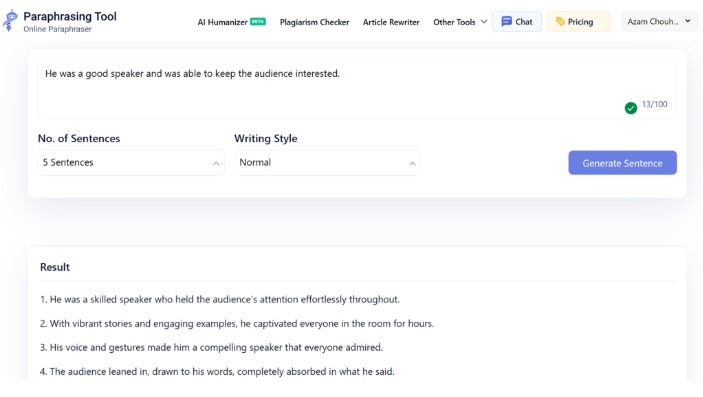
(Tool link: https://www.paraphrasing.io/ai-sentence-generator)
Check how the tool wrote the sentences in a new way. Then try writing your own version using the same idea. Do this regularly and your natural writing instinct will sharpen over time.
Crafting Your Words Carefully
Sentences are the building blocks of your writing. If your sentences are weak, your whole content feels flat. The tips in this blog cover the most common sentence problems that writers deal with every day.
Small changes like varying your openers, starting with action, or mixing a complex sentence with a short one can completely change how your writing feels. The more you pay attention to how you are writing in a sentence, the better your content will get over time.