

Tuesday at 10:17 a.m., the front desk is already underwater. One caller needs a new-patient visit. Another is waiting on a referral update. A portal message asks whether a lab result is normal. Billing is working denials, the physician is still closing yesterday's notes, and everyone is bouncing between patient care and admin cleanup.
That pressure is why medical virtual assistant services are getting real attention. But practices make a mistake when they treat every assistant as the same thing. A patient-facing AI bot, a remote human assistant inside the EHR, and a hybrid setup solve different problems and create different risks. The right choice comes from task risk, workflow fit, privacy governance, and escalation discipline, not from whichever vendor sounds the most advanced.
Privacy is the first place buyers get this wrong. HIPAA matters, but a signed agreement does not answer who can see messages, who can change records, who reviews edge cases, or how patients reach a human when automation stalls. Governance decides whether the tool reduces friction or creates a new safety problem.

Related Articles
- AI SEO Platform: What It Does and How to Choose One
- 7 Review Management Software Tools: A 2026 Buyer’s Guide
- Medical Virtual Assistant Services: A Practical Guide
- How AI Helps Brands Localize Video Campaigns
- AI Tools for Character Consistency in Brand Ad Filmmaking
- How to Solve Finder Search Problems on macOS Quickly
- 7 Essential Online Gaming Trends Transforming 2026
Start with direct operational questions. What actually counts as a medical virtual assistant? Which tasks belong with AI, which belong with remote staff, and which should stay with clinician-supervised humans even after automation works? What does compliance require beyond the HIPAA checkbox? How should a practice judge ROI and pricing without ignoring risk? And which patient-facing tasks should never be handed to a bot at all?
If you are running out of ideas and don’t know what to write or talk about, our random topic generator can help you quickly find simple and interesting topics for writing, conversations, and brainstorming with just one click.
Table of Contents
- A Tuesday at a Busy Clinic and the Questions That Follow
- What a Medical Virtual Assistant Actually Is
- Core Tasks and Where Each Type Fits Best
- Compliance and Security Beyond the HIPAA Checkbox
- How LatHire and MedicalVirtual.com Can Help
- ROI, Pricing Models, and What to Measure
- Choosing Between AI, Human, and Hybrid Vendors
- Implementing and Integrating a Medical Virtual Assistant
- Frequently Asked Questions About Medical Virtual Assistant Services
A Tuesday at a Busy Clinic and the Questions That Follow
It is 10:17 on a Tuesday. The phones are stacked, the portal is filling with refill requests, and a receptionist is trying to decide whether a message about dizziness belongs ahead of three insurance calls and two appointment changes. This is where clinics lose time and create risk. Everything arrives in one pile, even when the urgency is completely different.
A medical virtual assistant service can fix that, but only if the practice stops treating every assistant as interchangeable. A remote human assistant can work inside defined workflows, handle scheduling, update demographics, verify coverage, prepare referral and authorization paperwork, and route messages based on written rules. An AI assistant can answer routine operational questions, gather structured intake information, send approved instructions, and sort simple requests into the right queue. Neither one should make clinical judgments, interpret symptoms, or decide that a concerning message is safe to delay.
That line matters.
The first teams to feel relief are usually front-desk staff and physicians. Front-desk staff stop repeating the same instructions all day and get time back for exceptions, frustrated patients, and problems that need judgment. Physicians get cleaner inboxes, fewer interruptions, and less administrative noise mixed into clinically meaningful messages. Billing and referral teams benefit too, especially when documentation arrives in a more usable format instead of scattered across calls, portal threads, and sticky-note handoffs.
This is already an operating-model decision, not a future trend. As noted earlier, only a minority of surveyed practices had deployed conversational tools for patient-facing communication, and many were still weighing accuracy, privacy, integration, and ROI. That hesitation is reasonable. Patient communication is not the place to experiment without boundaries.
Start with the queue, not the vendor. Appointment requests, office hours, paperwork status, and basic intake are usually safer starting points than symptom triage, lab interpretation, or anything that can delay care if routed badly.
Practical rule: An assistant should take over a workflow only after the practice defines its boundaries, escalation triggers, owner, and audit trail.
That standard separates useful automation from expensive confusion. It also forces the core question: which tasks belong with AI, which belong with remote staff, and which should remain with clinician-supervised humans even after the automation appears to work?
What a Medical Virtual Assistant Actually Is
The idea predates modern chat interfaces. In 1971, researchers created INTERNIST-1, widely described as the first artificial medical consultant. The system's significance lies in its purpose: organizing clinical knowledge to support reasoning, not just answering administrative questions. That history matters because the phrase “virtual assistant” can describe everything from a scheduling agent to a system that supports structured clinical decision-making.
During the COVID-19 pandemic, Watson Assistant was deployed across 37 institutions in nine countries and generated more than 6.8 million responses over five months, with average interactions lasting two to three conversational turns, according to the historical review in this PubMed Central article on medical artificial intelligence. The deployment illustrates the value of concise, high-volume communication, but it doesn't establish that conversational software can replace clinical judgment.
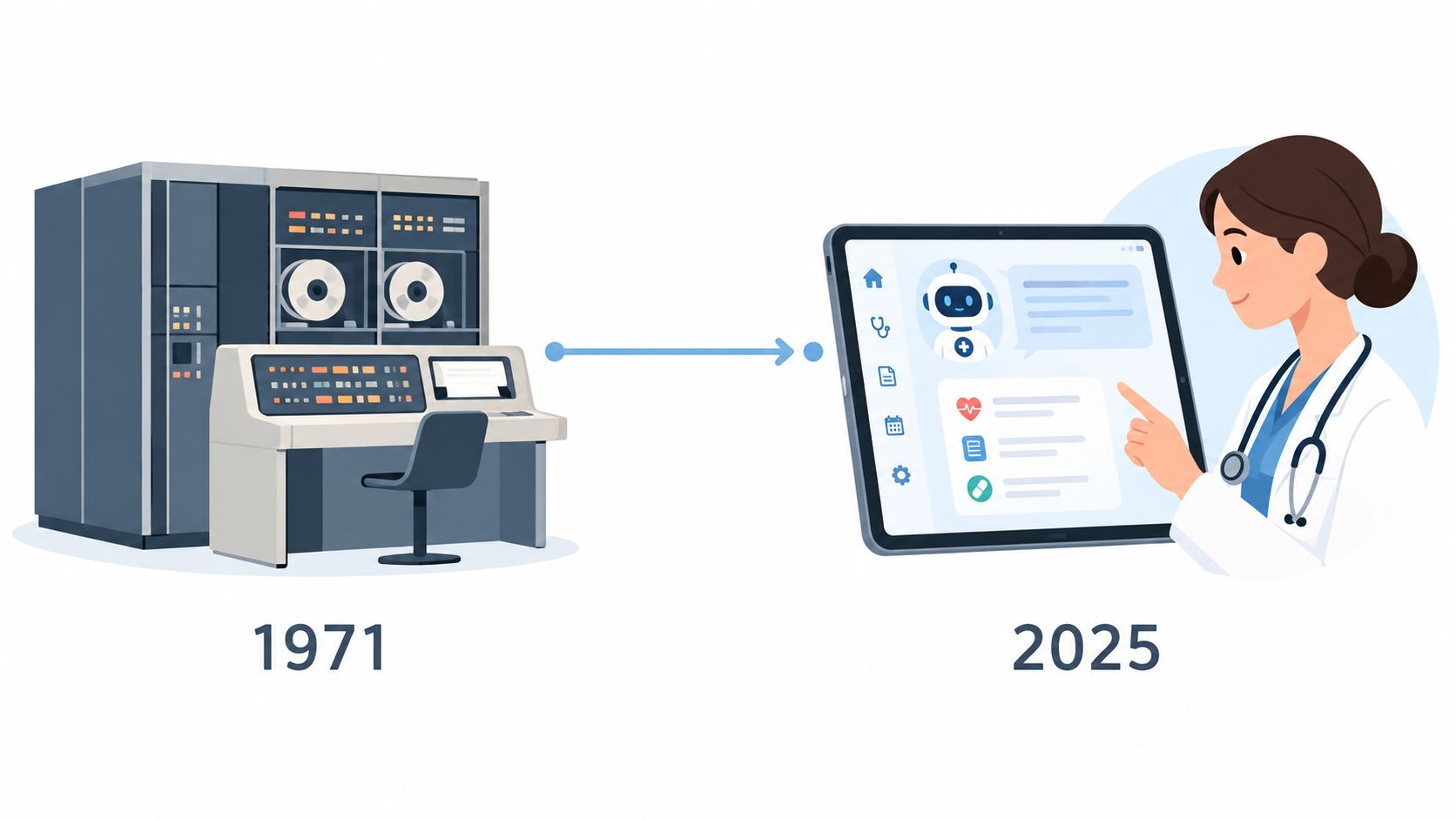
Three types belong in the same procurement conversation
AI assistants use chat, voice, workflow automation, ambient documentation, or retrieval from approved content. They're strongest when the request has a known intent and a controlled answer, such as checking office hours, collecting intake fields, or offering appointment slots.
Human remote assistants are trained staff who work through the practice's phone, scheduling, billing, referral, and EHR systems. They can interpret context, recognize ambiguity, ask follow-up questions, and escalate according to policy. Their limitations are operational rather than conversational: recruitment, supervision, continuity, training, and access control all need attention.
Hybrid assistants combine both. Software handles the first pass, while a trained human reviews uncertain requests, manages exceptions, and owns safety-sensitive communication. This arrangement often fits practices that want automation without forcing clinicians to supervise every routine interaction.
The term should therefore be used precisely. A virtual assistant may triage, draft, collect, summarize, and route. A licensed professional still diagnoses, prescribes, changes treatment, and signs off on consequential clinical decisions.
A virtual assistant extends a clinical workflow. It doesn't become the clinician.
That boundary should appear in vendor contracts, patient-facing disclosures, escalation scripts, access permissions, and quality reviews. If a supplier describes an assistant as “autonomous,” the practice should ask which decisions the system can make without human authorization and what happens when its confidence is low.
Core Tasks and Where Each Type Fits Best
Task selection should begin with the harm caused by an error, not with the number of clicks a system can automate. A useful model has three tiers.
Tier 1 handles predictable volume
Tier 1 contains low clinical-risk, high-volume work. Examples include scheduling, appointment changes, office FAQs, intake-form collection, insurance verification, prior-authorization paperwork, and after-visit summary delivery.
A patient asking for the location of a clinic can receive an automated answer. A patient requesting an appointment can enter preferred times and reason for visit, then receive a confirmation or staff callback. A human remote assistant remains valuable when eligibility rules, referral requirements, or scheduling exceptions complicate the request.
AI and human assistants can both perform well here, but the default should be determined by interaction complexity. AI suits stable rules and clear content. Humans suit fragmented workflows and practices where staff must coordinate across payers, specialists, and internal teams.
Tier 2 needs a reviewer
Tier 2 includes moderate-risk work, such as medication-refill routing, symptom intake, triage screening, and lab-result explanations. The assistant can gather structured information, identify the relevant queue, draft a response from approved content, or prepare a clinician review packet.
A refill request, for example, may require checks for the medication, prescriber, last visit, pharmacy, allergies, and protocol exceptions. An AI system can collect the fields, but a qualified reviewer should decide whether the request follows practice policy. The same applies to lab messages. A bot can explain terminology from approved material, but it shouldn't interpret an individual result as a diagnosis or tell a patient to alter treatment.
Tier 3 stays clinician-led
Tier 3 covers high-risk decisions and vulnerable moments. Differential diagnosis, treatment recommendations, mental-health crisis response, and emergency triage should remain clinician-led. A virtual assistant may capture the patient's words, identify a possible escalation trigger, and connect the person to the correct professional or emergency pathway.
Evidence on symptom and triage systems reinforces that caution. A systematic review and meta-analysis reported pooled triage accuracy of 0.86 for ChatGPT-4.0 versus 0.63 for ChatGPT-3.5, with substantial heterogeneity of I² = 93% and 84%, while an earlier evaluation correctly classified 74% of nonurgent cases but only 42% of urgent cases, as reported in the triage accuracy analysis.
Decision rule: The more harm a wrong answer could cause, the more human the workflow must remain.
The practical ceiling is clear. Automation can support data capture and routing in high-risk scenarios, but diagnosis, medication changes, crisis intervention, and urgent disposition require accountable clinical ownership.
Compliance and Security Beyond the HIPAA Checkbox
A clinic can buy a HIPAA-compliant tool and still create unsafe care. That happens when leaders treat privacy as a paperwork exercise instead of a governance system for data, outputs, escalation, and accountability. The central question is not whether a vendor encrypts records. It is whether the assistant stays inside approved tasks, routes risk correctly, and leaves a clear trail when something goes wrong.
For that reason, separate human remote staff from patient-facing AI. They do not create the same risk. A trained remote assistant working inside defined permissions can handle scheduling, referral follow-up, intake prep, and other operational work with supervision. An AI system interacting with patients introduces a different problem set, including disclosure, output control, emergency detection, and clinical review before action. Lumping both under one compliance label leads to bad purchasing decisions.
A practice should require a business associate agreement, encryption, role-based access, audit logs, retention controls, and documented deletion procedures. Those controls matter. They still do not answer whether the assistant gives safe advice, whether a patient knows AI is involved, whether patient data is reused to improve a model, or whether a clinician must approve the result before it reaches the chart or the patient.

Governance questions vendors should answer
Ask vendors to show how the full workflow is controlled, not just how data is stored.
- Storage and residency: Where are transcripts, recordings, prompts, and extracted patient fields stored, and which subcontractors can access them?
- Training use: Can patient data be used to train or improve a vendor model, and is there a contractual opt-out?
- Consent and disclosure: How does the patient learn that AI is involved, and how can the patient request a human?
- Emergency handling: What does the system do when a patient describes chest pain, suicidal intent, severe breathing difficulty, or another red flag?
- Human authorization: Which actions require a licensed professional to review and approve them?
- Change management: How are model updates tested, documented, and rolled back when performance changes?
Map the jurisdictions too. A patient may be covered by different privacy, localization, consent, consumer-data, or medical-device rules depending on where the patient, practice, vendor, and subcontractor operate. HIPAA does not settle obligations involving CCPA, GDPR, or medical-device classification in the United States and European Union.
Clinical safety needs measurement. Use approved clinical content, limit outputs to validated intents, log prompts and recommendations, set confidence thresholds, and require human authorization for diagnosis, medication changes, or urgent disposition. Even if automation performs well, some tasks should stay human because the downside of a wrong answer is too high.
Monitor the failure modes that matter in practice. Track under-triage, over-triage, unsafe advice, escalation latency, and clinician overrides across language, age, ethnicity, disability, and deprivation groups. The review of medical virtual assistant risks and controls also points to recurring problems such as hallucinations, inconsistent reasoning, missing nonverbal cues, privacy concerns, and equity risks.
The best vendor answer is a clear operating model for what the system can do, what it cannot do, who reviews it, where data travels, and how failures are detected.
How LatHire and MedicalVirtual.com Can Help
A practice that chooses a human or hybrid model still needs a reliable staffing route, and the right one depends on whether the gap is specialist clinical administration or a broader mix of roles.
MedicalVirtual focuses specifically on healthcare administration. It places HIPAA-trained remote professionals in roles such as patient intake coordination, medical reception, insurance verification, prior authorization, medical records, billing support, and virtual scribing. That specialization can help a clinic avoid treating recruitment as a separate project from workflow design. A practice can define a role for scheduling, referral coordination, intake review, or patient communications, then assess candidates against the actual EHR permissions and escalation duties the role requires.

LatHire connects US and Canadian companies with pre-vetted Latin American professionals across operations, technology, marketing, sales, and support. Its model combines AI assessments, skills evaluations, and human-led background checks, with support for hiring, international payroll, benefits, and legal compliance. For practices that want front-desk help alongside wider capacity, such as IT and EHR support, patient-support teams, or operations coordination, LatHire’s overview of medical virtual assistant services provides a relevant starting point. It also offers flexible engagement options with professionals working in the client’s time zone, which matters when a clinic needs coverage across a wider operating window.
Whichever route a practice takes, the useful question isn’t whether a remote assistant is cheaper than an in-house employee. It’s whether the role reduces clinician rework, unresolved queues, repeat contacts, abandonment, and unsafe escalation delays without creating a new supervision burden. A remote human can be the right choice when patient conversations require judgment, empathy, language flexibility, or coordination across systems.
Either service is a better fit when the practice wants human ownership of exceptions and has a manager available to define scripts, permissions, quality checks, and escalation standards.

ROI, Pricing Models, and What to Measure
A clinic does not get ROI from buying an assistant. It gets ROI from removing work that is currently tying up clinicians, front-desk staff, or referral coordinators. If the new system adds another inbox, another set of alerts, or another handoff that nobody owns, costs go up fast. The operational burden described in this healthcare virtual-assistant operations overview is the right starting point because it forces a harder question. Which tasks disappear, which tasks move, and which tasks still need a human every time?
That is why pricing should be read as an operating model, not a rate card.
| Pricing model | Best use | Usually includes | Common exclusions |
|---|---|---|---|
| Per encounter or interaction | Predictable AI conversations | Access to the assistant, approved workflows, usage reporting | Integration, complex escalation, specialist configuration |
| Hourly or per-FTE | Human administrative support | Assigned staff time, supervision structure, routine task execution | Training time, peak overflow, management and replacement coverage |
| Platform fee plus usage tier | Hybrid operations | Software, workflow configuration, human review layer, analytics | Custom EHR work, extensive clinical validation, additional coverage |
Per-interaction pricing can work for narrow, repetitive requests. It becomes expensive when the assistant fails to resolve the issue and staff must clean up the conversation. Hourly or per-FTE pricing is easier to understand for practices replacing backlog-heavy administrative work, but only if the proposal shows who trains the assistant, who covers absences, and who handles overflow. Hybrid pricing often looks sensible on paper because it spreads work between automation and people. It also creates the most hidden failure points if governance is weak.
Ask every vendor to separate recurring service fees from implementation, training, data migration, EHR integration, escalation handling, quality review, and governance. If those lines are bundled together, you cannot tell whether the low quote is real or whether your clinicians will pay for it later in correction work.
Measure the workflow, not the sales pitch
Start with a baseline. Then measure what changes in the live workflow, not what looks good in a demo.
- Deflection and resolution: How many requests are fully completed without another contact, and how many shift from the assistant to staff?
- Safety and escalation: How often are urgent cases identified, routed correctly, and brought to a clinician within the required workflow?
- Patient access: Where do patients abandon the process, ask for a human, or run into language, disability, or digital-literacy barriers?
- Clinical workload: How much rework do clinicians perform, and how often do they override or rewrite the assistant's output?
- Equity: Do completion, wait, escalation, and abandonment patterns differ across language and patient-access groups?
Expansion should be approved only when a defined bottleneck shrinks and hidden work does not shift back to clinicians. Practices building patient education, outreach, or service-line messaging alongside these workflows may also review content support options for business communication systems, but content operations are not clinical governance. Keep those decisions separate.
Choosing Between AI, Human, and Hybrid Vendors
The highest-risk task planned for automation should determine the vendor category. A practice shouldn't choose AI because its easiest workflow looks inexpensive, then expand the tool into triage. The ceiling must be set before procurement.
| Assistant Type | Best-Fit Task Tier | Clinical Risk Ceiling | Typical Cost Band | Integration Effort | Best-Fit Practice Profile |
|---|---|---|---|---|---|
| AI assistant | Tier 1, selected Tier 2 | Controlled information, routing, structured intake | Usage-based or platform subscription | Moderate to high, depending on EHR and voice channels | High-volume practice with stable content and strong internal oversight |
| Human remote assistant | Tier 1 and selected Tier 2 | Administrative work and supervised communication | Hourly or assigned-capacity model | Moderate, with training and access setup | Practice needing nuance, language flexibility, and exception handling |
| Hybrid assistant | Tier 1, Tier 2, structured Tier 3 intake | Clinician-supervised support for safety-sensitive work | Platform fee plus human-review capacity | High, because both layers need testing | Practice seeking automation while preserving human ownership |
What to demand from a shortlist
A vendor should provide more than a product demonstration. The shortlist should include:
- Approved content sources: The system should identify which clinical and operational materials supply its answers.
- Auditability: Logs should show the patient input, system response, escalation decision, reviewer action, and final disposition.
- Escalation ownership: Written rules should identify who receives urgent, ambiguous, or incomplete requests.
- Service commitments: Uptime, response handling, incident notification, and support responsibilities should appear in the agreement.
- Data controls: Residency, retention, subcontractor access, training-data use, and deletion should be explicit.
- Update governance: The vendor should explain how model or workflow changes are tested and approved.
- Specialty evidence: References should match the practice's specialty and task risk, not just general customer-service deployments.
- Adversarial testing: Red-team findings should cover unsafe advice, prompt manipulation, privacy leakage, and missed escalation triggers.
AI is fast and economical for repetitive interactions, but its risk rises sharply when language is ambiguous or clinical context is incomplete. Human assistants handle nuance better, yet they need training, supervision, permissions, and continuity planning. Hybrid vendors can offer the strongest design when they commit to written service levels for both the software and the human review layer.
Choose the assistant type that matches the highest-risk task planned for automation, not the lowest-risk task used in the demo.
A phased selection process works better than a broad rollout. Start with one Tier 1 workflow, verify access and reporting, test exception paths, then introduce a Tier 2 workflow with clinician sign-off. Tier 3 should remain a structured intake and escalation function unless the practice has a documented clinical governance program that supports any broader use.
For teams examining how software can support localized communication, AI helps brands localize video campaigns offers a separate content-operations perspective. It shouldn't be confused with clinical validation.
Implementing and Integrating a Medical Virtual Assistant
A clinic usually gets into trouble during implementation, not vendor selection. The failure pattern is predictable. A patient asks for a refill, mentions dizziness in the same message, the assistant routes it as routine, and staff discover the risk only after the chart review. That is why rollout should start with one narrow workflow and hard limits on what the system can do.
Use low-risk, high-volume tasks first. Appointment requests, routine FAQs, and form collection are sensible starting points. Symptom interpretation is not. Before any patient message reaches the assistant, assign one operational owner, approve the exact content it can use, lock the consent language, define the escalation path, and decide how success will be measured.
A practical rollout sequence
- Select one Tier 1 workflow. Map the current steps, queue owners, exception paths, and points where staff already intervene.
- Set the measurement baseline. Track resolution, abandonment, repeat contacts, time to staff response, and clinician rework before launch.
- Write the escalation page. Specify red flags, handoff language, emergency instructions, and after-hours routing.
- Connect the systems. Configure the EHR connection, identity controls, single sign-on, role-based permissions, and patient-matching rules.
- Test with safe scenarios. Include incomplete identities, duplicate charts, unclear requests, language needs, accessibility needs, and emergency statements.
- Pilot under supervision. Have staff review outputs, catch failures, and document corrections before expanding permissions.
- Add Tier 2 carefully. Keep refill routing, symptom intake, and patient-specific explanations behind trained human or clinician review.
Access control matters more than demo polish. A scheduling assistant should not be able to edit medication records. A documentation tool should not sign a clinical note on its own. Patient matching needs its own test cases because the right answer attached to the wrong chart is still a serious operational failure.

Review performance after launch
Review the deployment at 30, 60, and 90 days. Do not wait for complaints. Check under-triage, over-triage, unsafe advice, clinician overrides, escalation latency, patient feedback, and performance across language and access groups. Then keep reviewing. As noted earlier, safety problems do not disappear after a successful pilot.
Ask two contract questions in plain language. Are patient prompts or transcripts used for model training, and how does the practice opt out? What happens when a patient describes an emergency outside staffed hours? If the answer is a generic contact-your-provider message, the system is not ready for patient-facing use.
For workflow design around patient communication, digital convenience planning is a useful reference point. In healthcare, convenience only counts if consent, identity verification, human access, and clinical accountability stay intact.
Frequently Asked Questions About Medical Virtual Assistant Services
How quickly can a small practice see ROI?
A small practice should expect the answer to depend on workflow volume, integration effort, staffing coverage, and the amount of clinician rework removed. ROI becomes credible when the practice compares baseline and post-launch results for one bounded workflow, rather than counting every automated interaction as savings.
Can patient conversations train the vendor's model?
Sometimes, depending on the contract and vendor configuration. The practice should require a written statement covering training use, retention, subcontractor access, deletion, and opt-out rights. No patient data should enter model-improvement workflows without a documented legal and governance review.
What should happen when a patient reports chest pain?
The assistant should recognize the emergency trigger, provide the practice's approved emergency instruction, avoid diagnosis, collect only information needed for safe routing, and connect the patient to an appropriate human or emergency pathway. The escalation event should be logged and reviewed.
When might the assistant be a medical device?
Classification depends on the software's intended purpose, claims, decision impact, jurisdiction, and regulatory framework. A vendor should explain whether its product supports administrative communication, clinical decision support, diagnosis, treatment selection, or triage, then provide the applicable regulatory assessment for the markets served.
Is hybrid better than fully AI or fully human?
Usually, the strongest design is a documented split. Automation handles predictable Tier 1 work, while trained humans own ambiguity, patient-specific communication, and Tier 2 or Tier 3 escalation. The division should be visible to staff and patients, measurable in operations, and enforceable through permissions.
A clinic considering medical virtual assistant services should start with one repetitive workflow, write its escalation and consent rules, and measure patient access, safety, and clinician rework before expanding. For broader content planning around healthcare workflows, Random Topic Generator can help teams develop practical topics and communication assets at randomtopicgenerator.org.