
63% of the sources cited in Google AI Overviews were not in the conventional top 10, which means a page can shape an answer without owning a top blue-link position in the cited study. That single shift changes what an AI SEO platform has to do, because ranking position alone no longer tells the whole story.
A content team now has to make three decisions for almost every topic. It has to decide what to publish, what to fix, and what is working. Traditional SEO tools still matter, but they were built for a simpler search result page. Today's search results can surface a summary, cite sources that didn't rank first, and send fewer clicks to the open web.
If you are running out of ideas and don’t know what to write or talk about, our random topic generator can help you quickly find simple and interesting topics for writing, conversations, and brainstorming with just one click.
Table of Contents
- Why AI Search Just Changed the Job
- What an AI SEO Platform Actually Is
- Core Capabilities Every Platform Should Cover
- Where AI Search Helps and Where It Hurts
- How The SEO Agent Can Help
- A Realistic Content Team Workflow
- Evaluation Checklist for Buyers
- Measuring ROI Beyond Rankings
- Putting It All Together
Related Articles
- AI SEO Platform: What It Does and How to Choose One
- 7 Review Management Software Tools: A 2026 Buyer’s Guide
- Medical Virtual Assistant Services: A Practical Guide
- How AI Helps Brands Localize Video Campaigns
- AI Tools for Character Consistency in Brand Ad Filmmaking
- How to Solve Finder Search Problems on macOS Quickly
- 7 Essential Online Gaming Trends Transforming 2026
Why AI Search Just Changed the Job
AI Overviews have moved fast enough to change planning habits, not just reporting. A Semrush analysis of more than 10 million keywords found that AI Overviews appeared in 6.49% of tracked searches in January 2025 and 13.14% by March 2025, more than doubling in roughly two months in that analysis. That pace matters because it turns AI search from an edge case into a recurring part of the search environment.
The practical problem is simple. A rank tracker can still tell a team where a page sits in a list, but it can't always tell the team whether the page is being used as a source, whether it is answering a subquestion, or whether it is being bypassed by a summary. Search teams used to ask, “Did we move up?” Now they also have to ask, “Did the page get cited, mentioned, summarized, or skipped?”
The new job is decision support
An AI SEO platform is useful only if it helps a team make better publishing decisions under that new reality. That means it should help decide whether a topic deserves a new page, whether an existing page needs a deeper section, and whether a technical issue is blocking visibility altogether. A dashboard that merely reports rankings doesn't solve that.
Practical rule: if a tool can't separate citation visibility from click visibility, it's still thinking like a rank tracker.
A content lead will recognize the situation quickly. A page ranks well, traffic holds steady for a while, and then the team notices that search results are answering the question before the click ever happens. At that point, the question isn't whether SEO still matters. It's which parts of the page deserve to be rewritten, restructured, or protected.
What an AI SEO Platform Actually Is
A good way to think about an AI SEO platform is as a librarian that doesn't just shelve books, it reads them, compares them, and tells a writer which missing pages matter most. It should understand topic coverage, identify the passages that answer a question, and point out where a page is too thin to be useful. That's very different from checking whether a keyword appears often enough.
Google's own ranking documentation helps define the category. Google says its systems evaluate hundreds of billions of pages using BERT for language interpretation, neural matching for concept-level alignment, RankBrain for relating words to concepts, and passage ranking for identifying relevant sections within a page in its ranking systems guide. In plain English, that means relevance is not just about a whole page and not just about exact-match words.
What the platform should understand
A useful platform should map a query to intent, then map that intent to entities, subquestions, and supporting passages. It should show whether a page covers the core topic, whether it covers enough adjacent ideas to feel complete, and whether a specific section is likely to earn attention. That is the point where semantic analysis becomes practical instead of decorative.
A strong platform treats each page as a set of answerable sections, not as a single block of text.
That distinction matters because two pages on the same site can be very different in usefulness. One may be broad but vague. Another may be narrow but exact. A rank tracker often flattens that difference. A real AI SEO platform surfaces it.
Core Capabilities Every Platform Should Cover
The best way to evaluate a platform is not by its menu labels. It is by the recurring jobs a content team needs it to do. If a demo can't handle these five jobs, the platform is probably flashy, but shallow.
| Capability | Team Job | Input Required | Warning Sign |
|---|---|---|---|
| Keyword and intent research | Pick topics worth publishing | Search demand, query clusters, audience segment | It only shows keyword volume without intent grouping |
| On-page and semantic optimization | Strengthen drafts and refresh old pages | Draft text, headings, entities, internal links | It gives generic writing tips instead of section-level guidance |
| Technical SEO and crawl health | Remove visibility blockers | Crawl data, rendered HTML, robots rules, canonicals | It reports issues without showing which templates or URLs are affected |
| SERP and AI visibility forecasting | Judge likely outcomes before publishing | Search results data, page type, query type | It offers a single score without explaining the trade-off |
| Workflow automation | Move from research to draft to publish | CMS access, approvals, content briefs | It stops at suggestions and never closes the loop |
Start with visibility prerequisites
Google says pages must be crawlable, indexed, and eligible to appear with a snippet before they can serve as supporting links in AI Overviews or AI Mode, and it says no special AI file or dedicated schema.org markup is required in its AI features guidance. That means a platform's technical audit can't be cosmetic. It has to test HTTP access, robots directives, canonicalization, rendered HTML, internal-link reachability, and snippet eligibility.
A weak tool often overpromises on schema and underdelivers on crawling. A stronger one looks at the whole path from bot access to visible result. For a content team, that is the difference between a recommendation that sounds smart and one that changes what can be indexed.
For a broader marketing workflow example, this content-solutions overview can help teams see how topic discovery and publishing fit together.
Where AI Search Helps and Where It Hurts
AI search can increase exposure while reducing visits. Analysts in a 2025 Authoritas study of 3,500 UK publisher queries found AI Overviews on 12.2% of searches, and when they appeared, publisher click-through rates fell 47.5% on desktop and 37.7% on mobile in the published report summary. That is a clear signal that the same feature can create visibility while suppressing traffic.

Citation value is not the same as visit value
Pew's browsing research shows the same split in plain terms. Only 8% of users who encountered an AI summary clicked a link to visit a website in the cited study summary. A page can earn a citation, build trust, and still lose the visit. For content teams, that means citation visibility and click visibility need to be measured separately.
Informational queries are the easiest for AI systems to answer on the page. Commercial and navigational queries behave differently because users still need pricing, a login, a comparison table, or a product page. The practical response is to match the strategy to the query type instead of chasing one broad AI score.
If a page protects proprietary data, a calculator, a live tool, or first-party research, that asset often deserves click preservation more than citation chasing.
That split is the part many teams miss. Citation visibility can build authority. Click visibility can drive sessions. Sometimes the right move is to make the page more quotable. Sometimes it is to make it harder to replace.
How The SEO Agent Can Help
A useful platform doesn't start at drafting, it starts at topic selection. For teams that need a clear path from idea to publish, the AI SEO platform from The SEO Agent is built around that pipeline, from keyword research through publishing. It's most relevant when the team needs to move quickly without losing structure.
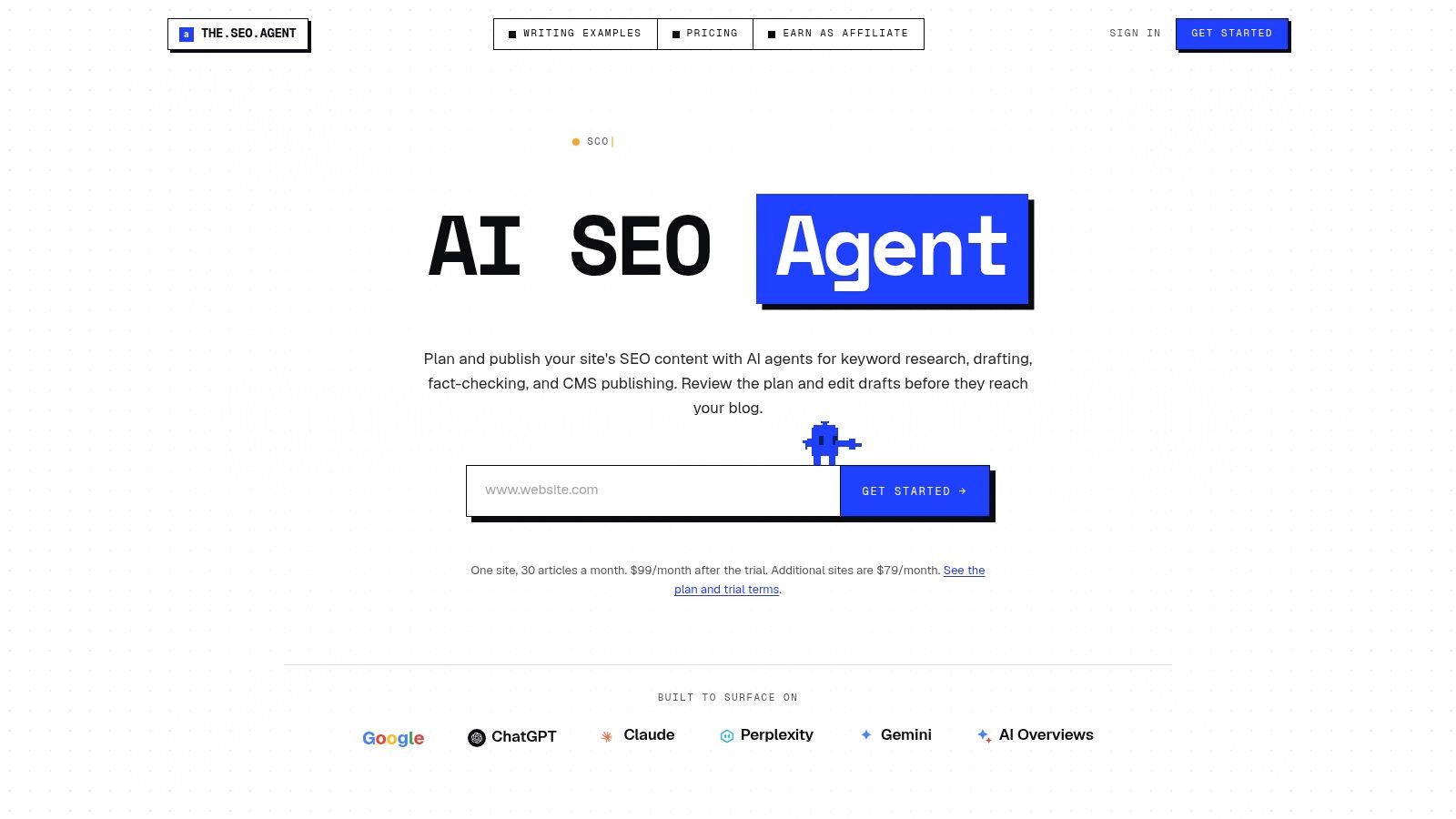
A realistic two-week workflow starts with a topic cluster, then filters out overlaps, then turns the surviving ideas into a brief, then a draft, then a measured publish. The SEO Agent's appeal is that it tries to connect those handoffs instead of leaving them as disconnected tasks. That matters for lean teams, because every extra copy-paste step becomes a delay.
Where it fits best
It makes the most sense for founders, small marketing teams, and operators who want one place to move from research to draft to CMS. It is less useful if the team already has a full editorial ops stack and only wants a single point solution for audits. A platform earns its keep when it removes friction without hiding the reasoning.
Three practical benefits stand out here. It can reduce blank-page paralysis by starting from live topic opportunities, it can keep drafts aligned to search intent, and it can help a team publish without juggling multiple tools. The core value is not “AI writing” in the abstract. It's a tighter workflow around decisions that matter.
A Realistic Content Team Workflow
Before anyone opens a draft, the workflow should already have three commitments in place: the seed topic, the cluster, and the canonical URL. That gives the team a single home for the page, so authority does not splinter across near-duplicate articles. From there, the writer drafts with semantic guidance, the SEO lead checks technical issues, and the team publishes only after the page can be crawled and indexed.
Why clusters beat random publishing
Clusters reduce cannibalization because each page has one job. If three articles answer the same question, none of them becomes the clearest source. A canonical URL gives the platform a stable target, which makes internal linking and measurement easier to read.
Simple rule: one query cluster, one primary URL, one measurement plan.
A team can also use a sentence-level prompt helper such as this guide to crafting interesting, engaging sentences when drafts stall on transitions or section openers. Weak openings can make a solid outline feel flat, so support at the sentence level still matters.
A buyer should test the workflow in this order:
- Topic selection: Does the platform propose a real cluster, or only a loose keyword list?
- Draft support: Does it shape headings, entities, and missing subquestions, or just rewrite sentences?
- Technical check: Does it flag crawl, indexing, and canonical issues before publish?
- Publishing handoff: Does it move cleanly into the CMS, or stop at a draft file?
- Measurement loop: Does it track rankings, citations, and referral quality separately?
That sequence shows whether a platform supports the full handoff chain, or only the middle of it.
Evaluation Checklist for Buyers
The fastest way to compare vendors is to score them against the decisions a team will make. A polished demo can hide weak data, vague pricing, or poor export options. A short pilot on one cluster of pages usually shows the truth faster than a generic sales call.
What a buyer should test
| Area | Pass signals | Fail signals |
|---|---|---|
| Features | It handles topic research, semantic guidance, technical checks, and measurement in one flow. It shows page-level recommendations, not just sitewide scores. | It focuses on content generation only. It offers generic “AI insights” without explaining how they affect a URL or query cluster. |
| Integrations | It connects to the CMS, Search Console, and analytics stack. It exports clean data for BI tools. | It requires manual copy-paste. It traps reporting in the interface and won't export structured data. |
| Data sources | It explains whether keyword data is first-party, licensed, or blended. It identifies how search and crawl data are refreshed. | It hides the source of its data. It uses vague claims about “proprietary intelligence” with no explanation. |
| Privacy and data handling | It offers SSO, role-based access, and clear data retention terms. It explains how customer content is stored and whether residency controls exist. | It has no audit logs. It can't explain data residency. It is vague about who can access uploaded drafts or site data. |
| Pricing model | It states whether limits are per user, per query, per project, or per publish. It shows the cost of scaling a pilot into production. | It buries usage limits. It makes the monthly price look simple while charging separately for exports, seats, or volume. |
A team should also ask for one short pilot, not a broad trial across the whole site. One cluster of pages is enough to test whether the platform can support research, drafting, approval, and measurement without friction.
If a vendor can't explain its methodology, can't produce audit logs, or can't show where the data came from, that's a red flag. So is a demo that keeps returning to generic AI language instead of page-level proof.
Measuring ROI Beyond Rankings
ROI becomes clearer when the team separates three different outcomes. Traffic can convert. Citation visibility can build authority. Zero-click exposure can still shape a later branded search, even when the visit happens later.
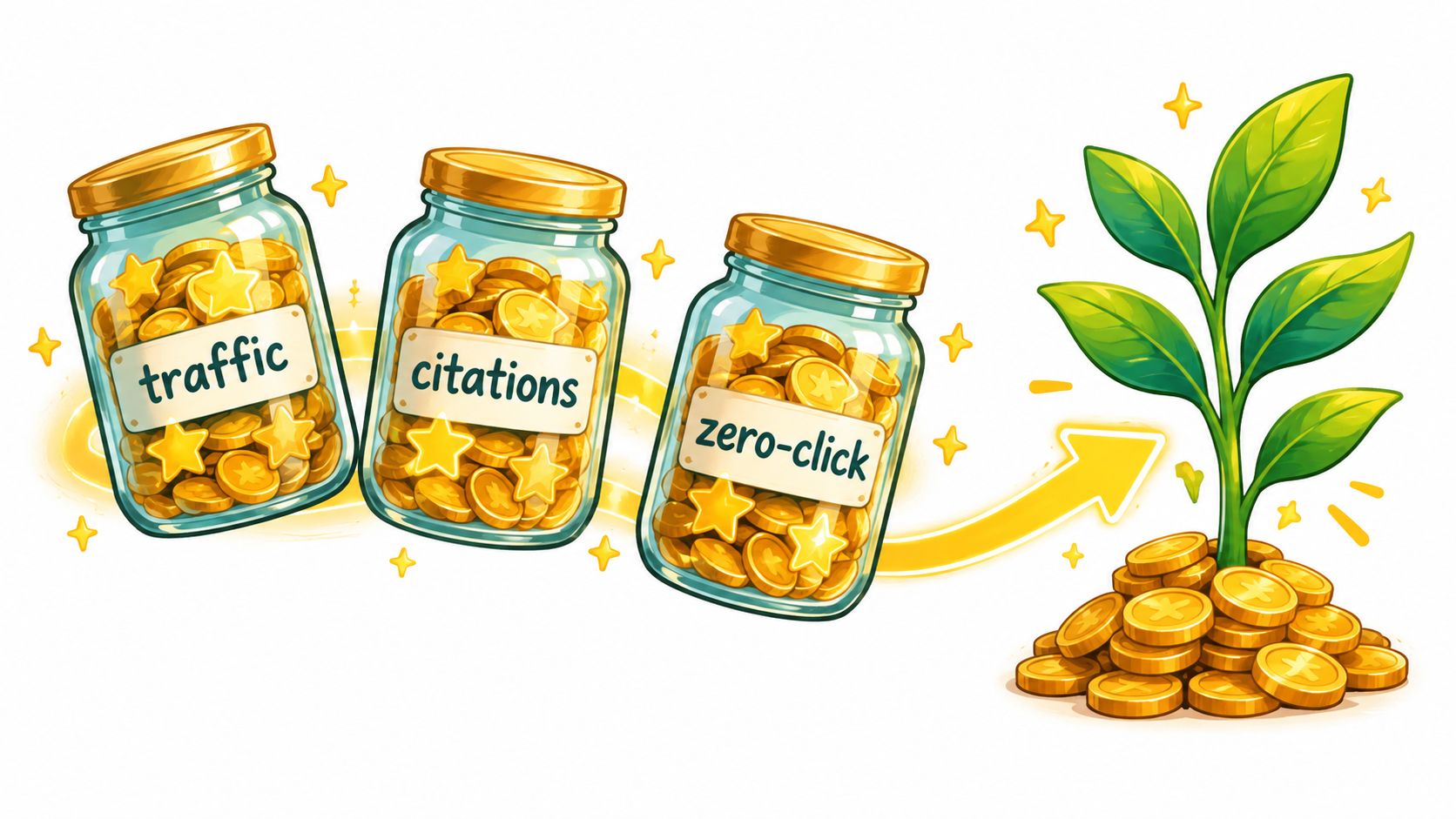
Citation visibility needs its own tracking because it does not map cleanly to rank position. A page can help with authority even if it is not the page sending the most direct clicks. That is why citation and click visibility should sit on different lines in the dashboard, instead of being collapsed into one number.
A simple dashboard layout
A practical dashboard can use three columns: brand mentions, assisted conversions, and AI Overview presence. That lets the team see whether an answer is building awareness, sending visits, or supporting a later conversion path. It also avoids the common mistake of judging AI exposure by direct sessions alone.
The third column matters because visibility can create value before the click. A useful example is branded search lift, where more people search for the company name after repeated exposure in answer surfaces. That is a different outcome from immediate traffic, and it should be measured separately.
When budgets are tight, the choice should be direct. If the goal is trust building, citation visibility may be enough. If the goal is lead capture, click preservation matters more. If the goal is product education, the page may need a different format entirely, such as an interactive tool or a gated asset.
Putting It All Together
An AI SEO platform should help a team make three decisions well. It should clarify what to publish, what to fix, and what to measure. Everything else, from keyword lists to content scores, only matters if it improves one of those three calls.
A simple first move this week is to pick one topic cluster and run it through a full decision check, from crawl health to citation potential to post-publish measurement. That keeps the conversation grounded in one real surface, not a theoretical feature list.
Treat the platform as decision support, not a magic button. The best tools sharpen judgment, they don't replace it.
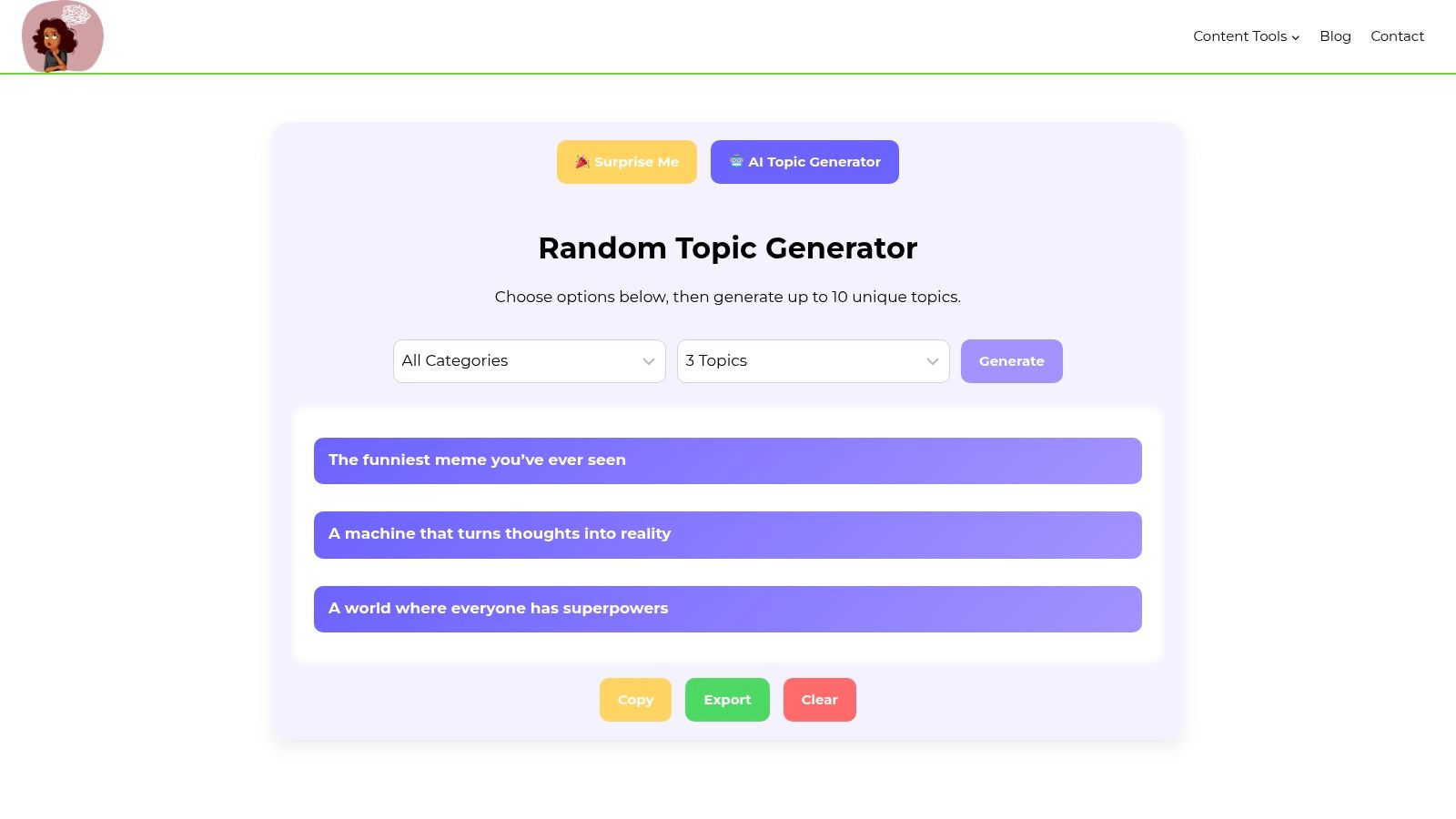
For teams that want help turning a topic seed into a structured cluster, Random Topic Generator can be useful at the very start of the planning process, especially when the brief needs a fast, neutral way to break out of blank-page mode.